
Mar 25, 2025
What is Amalgam Filling?
While there are many types of fillings available, what is amalgam filling? Amalgam fillings have been…
Lindsay Lohan’s brighter, more symmetrical smile is often linked to modern cosmetic dentistry, most commonly professional whitening paired with veneers or similar ceramic restorations. While only her dentist could confirm the exact work, her “before and after” look matches the typical results of smile design: improved tooth color, shape, and alignment with a natural finish.
Lindsay Lohan is an American actress and singer who rose to global fame as a child and teen, notably with roles in *The Parent Trap* (1998) and *Mean Girls* (2004). Like many public figures, her appearance has been closely followed over the years, including changes in her smile.
Lohan has not publicly shared a detailed treatment plan, so any discussion of specific procedures is educated speculation. That said, the consistency of her tooth color, the more uniform front-tooth edges, and the overall symmetry seen in later photos are all common outcomes of cosmetic dentistry and smile design.

When a celebrity’s smile changes noticeably, it is usually the result of a small combination of treatments rather than one single procedure. Below are the most common options that match the type of results seen in many Hollywood smile transformations.
Veneers are thin shells that cover the front of teeth to improve shape, color, and minor alignment issues. They’re often chosen to correct uneven edges, worn enamel, stains that don’t respond well to whitening, or small gaps. A well-planned veneer case should keep the result proportional to the face, avoid an overly opaque shade, and preserve as much natural tooth as possible.
Whitening is frequently used on its own or before veneer placement to ensure the surrounding teeth match the final shade. In-office whitening typically offers faster, more controlled results than over-the-counter products, especially for people with long-term discoloration.
Bonding uses tooth-colored composite resin to smooth small chips, refine edges, or close tiny spaces. It is less invasive than veneers and can be an excellent option when changes are modest, though it may stain or wear faster than ceramics.
If a tooth is heavily restored, structurally weak, or has had root canal treatment, a crown may be recommended instead of a veneer. Because crowns require more tooth reduction, they should be chosen for clinical reasons, not purely for cosmetics.
The material choice affects longevity, stain resistance, and how natural the teeth look in different lighting. In cosmetic cases, dentists typically select from the options below based on bite, enamel condition, and desired translucency.
High-quality ceramics can closely mimic natural enamel, including light reflection and translucency. They also resist staining better than resin-based materials, which is why they’re widely used for veneers and other aesthetic restorations.
Composite resin is shaped directly on the tooth and polished to match the surrounding enamel. It’s commonly used for bonding, small contour changes, or temporary aesthetic improvements when a patient wants a more conservative approach.
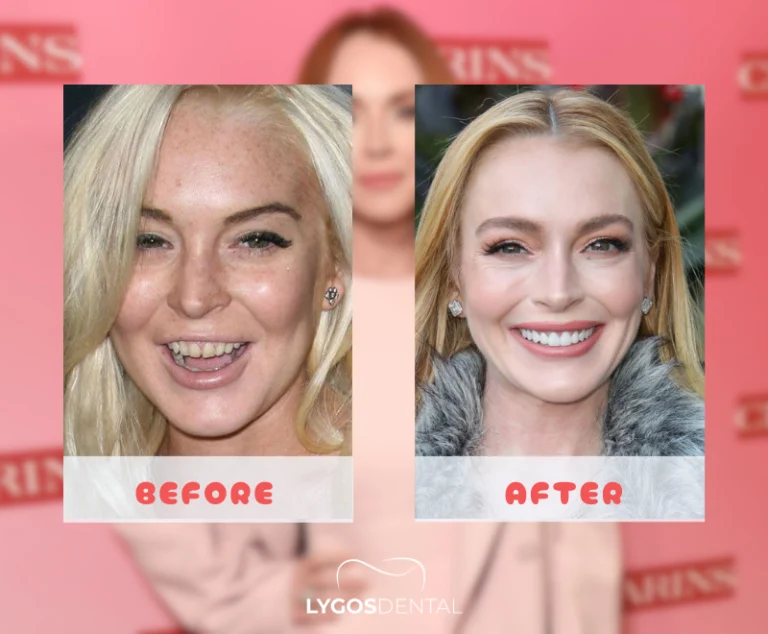
Earlier photos often show a more natural, slightly uneven smile with visible wear and mild discoloration—features that are common and not “bad” teeth. In more recent appearances, her teeth look brighter and more uniform in length and shape, with smoother edges and a more consistent shade. Those are classic visual markers of smile design, especially when veneers or ceramic restorations are involved.
Turkey remains a popular destination for dental tourism because clinics often offer competitive pricing and package-style planning for international patients. Prices vary by city, clinic reputation, clinician experience, and the material selected.
As a broad guide, veneers in Turkey are often quoted in the range of about $200–$500 per tooth for many common options. Premium ceramics such as lithium disilicate may be priced higher, while composite options may be lower. A final quote depends on how many teeth are treated and whether you need additional work such as gum shaping, bite correction, or temporary restorations.
Cosmetic dentistry can be excellent when planned well, but poor technique or rushed treatment can create long-term issues such as sensitivity, gum irritation, and difficult maintenance. If you are comparing clinics, look for evidence-based planning and clear documentation—not just “before and after” photos.
Yes—she publicly confirmed Zoom teeth-whitening with Dr. Bill Dorfman in 2011.
No—she hasn’t publicly confirmed veneers; media and dentists’ analyses are speculative.
No—there’s no credible report or confirmation that she has dentures.
Yes—she confirmed professional Zoom whitening in 2011; other procedures aren’t publicly confirmed.
Confirmed: Zoom whitening in 2011; veneers or other cosmetic work remain unconfirmed.
