
Aug 25, 2025
Turkey Dental Veneer Prices 2026 | LYGOS DENTAL
n this guide, you can find updated information on Turkey dental veneer prices in 2025, factors…
Black lines on teeth are usually caused by surface staining or hardened plaque (tartar) collecting near the gumline or between teeth. Less commonly, a dark line can signal early tooth decay or an aging restoration. A dental exam confirms the cause, and professional cleaning, stain removal, or restorative care can usually clear the line safely.
Thin dark streaks can show up suddenly or build slowly over time, often where plaque is hardest to remove. Some are purely cosmetic, while others are an early warning sign of decay or gum disease. Knowing what the line represents makes it easier to choose the right fix and prevent it from coming back.
Most black lines are a type of extrinsic discoloration—stain sitting on the surface—or darkened tartar at the gum margin. Because tartar is mineralized plaque, it can’t be brushed off at home once it forms. If the line looks like it is “inside” the tooth, spreads, or sits at the edge of a filling or crown, decay or leakage around dental work becomes more likely.
Several issues can create the same visual problem, so appearance alone isn’t a perfect guide. These are the most common causes dentists see:
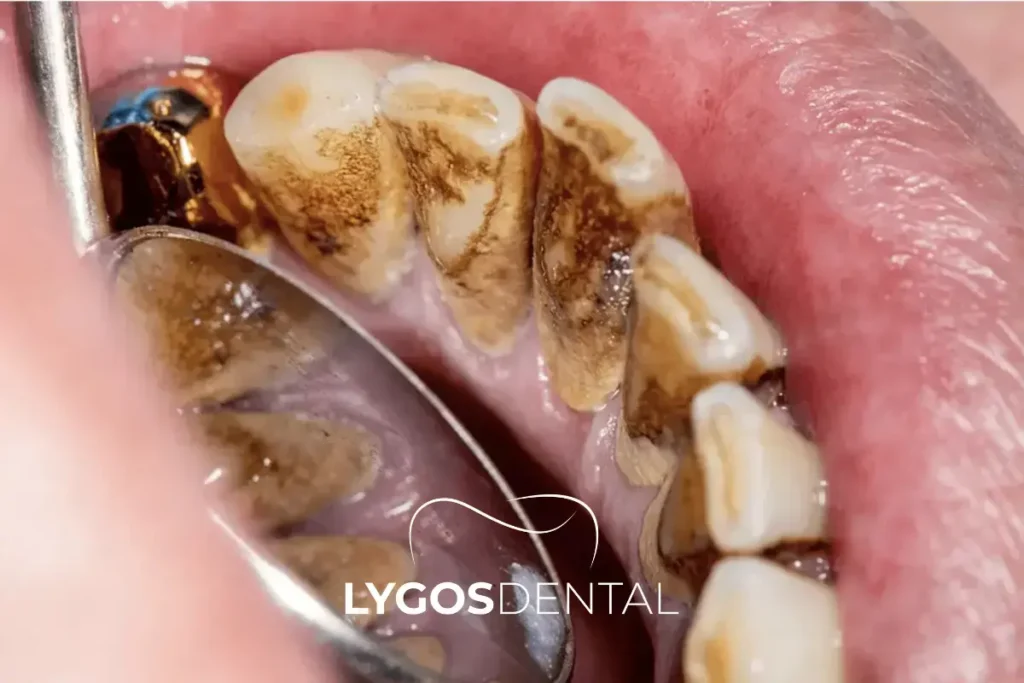
When plaque is left in place, it hardens into tartar (also called dental calculus). Tartar can trap pigments from food, drinks, or smoking and may look brown or black along the gumline. Only a dentist or hygienist can remove it with professional instruments.
Some oral bacteria produce pigments that stick to the tooth surface. This often shows up as black dots or a thin line at the cervical third of the tooth (close to the gumline) and is seen frequently in children, though adults can get it too.
Coffee, tea, red wine, cola, and tobacco can leave dark stains that collect in grooves, between teeth, or where plaque is retained. If you drink or smoke frequently, stains can reappear quickly after cleaning.
A dark line that expands, feels rough, or catches floss can be an early cavity. Decay is more suspicious when the area is soft, sensitive, or located around an old filling.
As gums recede, the root surface becomes exposed. Root surfaces are more porous than enamel, so they can pick up stain easily, creating a darker line along the gum margin.
Older crowns or restorations that contain metal can sometimes create a dark edge at the margin. A visible line may also mean the restoration is aging or no longer sealing perfectly.
Dentists often use the pattern and location to narrow down the cause:
Many surface stains and tartar deposits don’t hurt. If the black line comes with bleeding gums, persistent bad breath, swelling, or sensitivity to cold or sweets, book a dental visit sooner rather than later.

The best treatment depends on the diagnosis. Your dentist may use one or more of the following:
Routine cleaning removes plaque, tartar, and many surface stains. It’s the most effective first step for black calculus or gumline staining.
Air polishing uses a controlled stream of air, water, and fine powder to lift stubborn extrinsic stains from enamel and hard-to-reach grooves.
When discoloration is embedded in the enamel, whitening can brighten the tooth after the surface is cleaned. Whitening won’t remove tartar and should be done after a professional exam.
If decay is the cause, your dentist removes the damaged area and restores the tooth with a filling or another suitable option.
If the dark line is caused by an older restoration, replacing it with a modern material (often all-ceramic) can improve both the seal and the appearance.
If there is gum inflammation or deep tartar below the gumline, treatment may include deeper cleaning (scaling and root planing) and a tailored home-care plan.

Prevention is mostly about reducing plaque retention and limiting stain exposure. These habits make the biggest difference:
Book an appointment if the line is new and spreading, you notice sensitivity, or there’s a dark edge around a filling or crown. Seek prompt care for swelling, pus, fever, or significant pain. A quick exam can rule out cavities and gum problems and save you from bigger treatment later.
Remove black lines by professional cleaning, polishing, or treating decay at a dentist.
Treat black marks with brushing, flossing, whitening, and dental evaluation for stains or decay.
Black lines are caused by stain, tartar buildup, enamel cracks, or cavities.
Some black lines are reversible with cleaning; lines from cracks or decay aren’t.
Black lines require a filling if they indicate tooth decay, not simple staining.
